Running a successful dental practice means keeping a close eye on costs, and supplies are one of the areas where overspending can quietly erode your margins. But before you can fix the problem, you need to understand it.
The truth is, there’s no single figure that works for every practice. Spend varies depending on your size, the procedures you offer, your patient volume, and the specialism of your team. What matters is knowing your own numbers, and having a benchmark to measure them against.
What Should You Actually Be Spending?
It’s worth separating lab costs from general supplies, as they behave quite differently.
According to Christie’s Dental Report¹, lab spend sat at around 9% of revenue before the pandemic. It has since risen to an average of 15%, driven largely by higher labour, shipping, and raw material costs, pressures that show no immediate sign of easing.
General dental supplies tell a different story. Excluding lab, the average practice is currently spending around 6% of turnover on supplies in 2026. That figure has crept up from around 5% in recent years, and for many practices it’s higher than it needs to be.
Practices with a disciplined approach to dental supplies procurement are consistently achieving general supply spend below 4.5%, and in many cases, below 4%. The gap between average and achievable is significant, and largely comes down to how purchasing decisions are made.

Why Costs Drift Higher Than They Should
Most practices don’t overspend out of carelessness. It tends to happen gradually, through a combination of factors:
- Prices increase from suppliers and aren’t routinely challenged
- Ordering happens reactively rather than strategically
- There’s no clear ownership of purchasing and inventory management within the practice
- Purchasing decisions are made in isolation, without the benefit of market comparison
Individual practices also lack negotiating power. Suppliers reserve their best terms for buyers with genuine big volume, which is why a Group Purchasing Organisation (GPO) can make a meaningful difference. By pooling the purchasing power of many practices, a Group Purchasing Organisation (GPO) negotiates pricing that no single practice could achieve on its own.
Building a Smarter Approach to Supply Spend
Regardless of the size of your practice, a more structured approach to procurement will reduce costs without compromising care. Here’s where to start:
Audit your current spend. Go back through the past twelve months and establish exactly what you’ve been spending on supplies, across both lab and general categories. Until you have a clear picture of where money is going, it’s difficult to make meaningful changes.
Set a realistic target. Most practices should be aiming for general supply spend of between 3.5% and 4.5% of turnover. Use this as a working goal, and revisit it regularly as your practice evolves.
Tighten up inventory. Good dental inventory management means knowing what you have, what you need, and what you’re ordering out of habit rather than necessity. Overstocking ties up cash; understocking disrupts care. Both are avoidable with the right systems in place.
Review your procurement process. Effective dental supplies procurement isn’t just about finding cheaper products, it’s about buying smarter. That means consolidating suppliers where possible, reviewing product choices periodically, and ensuring you’re not paying more than the market rate for routine items.
Consider your purchasing power. If you’re buying independently, you’re likely paying more than you need to. A dental buying group typically focuses on giving members access to pre-negotiated discounts. A dental Group Purchasing Organisation (GPO) goes further. It combines the purchasing power of multiple practices to negotiate supplier agreements, improve pricing and help practices manage procurement more effectively.
Dentstock operates as a dental GPO, using aggregated purchasing power, procurement data and technology to help independent practices access terms normally associated with much larger dental groups, while remaining fully independent.
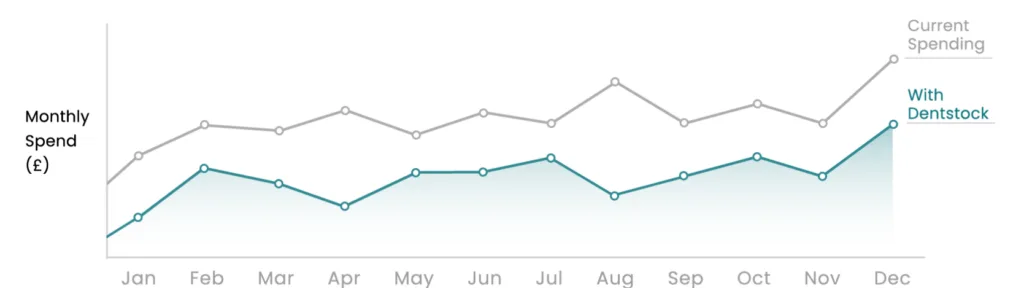
So, Are You Spending Too Much?
If your general supply spend is sitting above 6% of turnover, the answer is almost certainly yes. If it’s between 4.5% and 6%, there’s meaningful room for improvement. If it’s already below 4.5%, you’re ahead of the average, but there may still be gains available, particularly on lab costs.
The practices that manage supply spend most effectively share a few things in common: they treat procurement as an ongoing discipline rather than a periodic task, they use data to guide decisions, and they make sure they’re not navigating the market alone.
If you’re looking to save money on dental supplies, the starting point is visibility, knowing exactly what you’re spending and where. From there, the right combination of smarter processes, better inventory control, and stronger purchasing relationships can make a material difference to your bottom line.
Dentstock works with practices across the UK to bring supply costs down through collective buying power, supplier negotiations, and practical procurement support. If you’d like to understand what’s achievable for your practice, we’re happy to walk you through it.