
How much should we be spending on supplies?
If you’ve never sat down and worked out your supply spend as a percentage of turnover, it’s worth five minutes with your last few invoices. It’s one of the simplest numbers in your practice’s finances, and one of the easiest to get quietly wrong for years without noticing.
The benchmark
Across UK dental practices, supply spend typically sits around 5% of turnover. That’s the average, not the target.
Among the practices we work with, the best performers run at around 3%. That’s not a typo, and it’s not a fluke. It comes down to buying power, pricing discipline, and knowing what similar practices nearby are actually paying for the same products.
A realistic, achievable target for most independent practices is 3-4%. We’d call that an A* result. It’s not always reachable for every practice, and it isn’t meant to be a one-size-fits-all number. What you buy, how you run your clinical mix, and your own preferences on brands and materials all affect where you land. But if you’re sitting at 5% or above, there’s very likely room to move.
What counts as "supplies" here
This percentage should cover consumables, PPE, small disposables, and the everyday clinical materials you reorder regularly. It doesn’t include equipment (generally anything above £500 per item), and it doesn’t include lab fees. Practices sometimes miscalculate their own percentage by including or excluding the wrong things, which is worth double-checking before you compare yourself to the benchmark.
How to calculate it yourself
You don’t need an accountant for this. It’s one calculation:
- Pick a quarter. Ideally your most recent complete one, since you want current pricing rather than last year’s.
- Add up your total supply spend for those three months. Go through your invoices and sum everything that counts as supplies, using the definition above.
- Get your turnover (fee income) for the same three months. This should already be sitting in your practice management software or accounts. Just make sure it’s the same window as step 2.
- Divide supply spend by turnover, then multiply by 100.
(Supply spend ÷ Turnover) × 100 = Supply spend as % of turnover
For example, £14,000 of supplies against £200,000 of turnover in a quarter gives you (14,000 ÷ 200,000) × 100 = 7%.
One caveat: a single quarter can be skewed by one unusually large order, or an unusually quiet one. If your number looks off from what you’d expect, check the previous quarter too, or compare against the same quarter last year, before drawing any conclusions.
Why a good percentage doesn't happen by accident
Practices at 5% aren’t usually overordering. In our experience, the far more common cause is simply paying more per unit than a similar-sized practice down the road, often without realising it. A few of the usual culprits:
-
Small price increases on frequently reordered items that are easy to miss
-
Bundled invoices, where one line item’s increase disappears into a total that still looks reasonable
-
Rates a rep set years ago that were fair at the time and have never been renegotiated since
None of these shows up as a single alarming number. They show up as your percentage sitting a point or two higher than it should, quietly, every month.
What the difference actually looks like on your bottom line
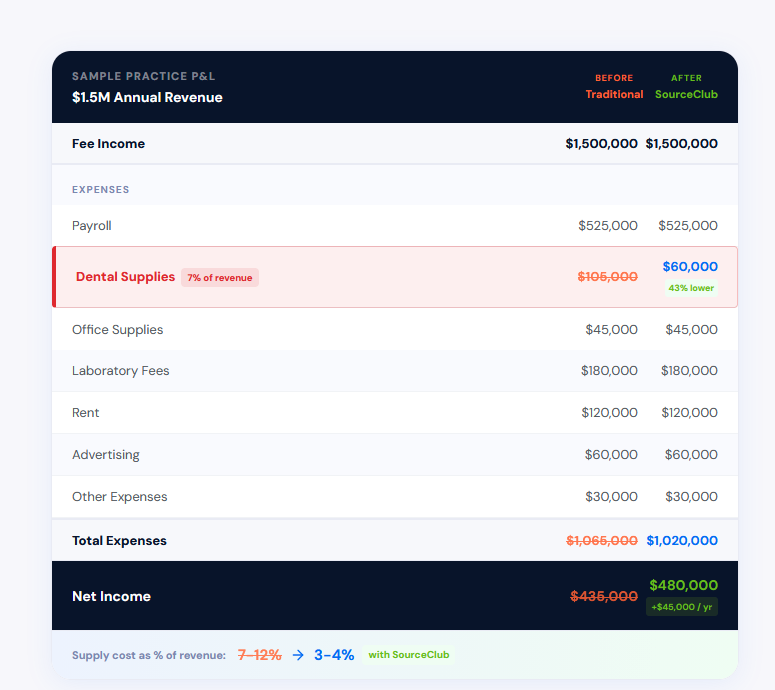
Here’s a worked example on an £800,000 turnover practice going from £50,000 to £32,000 in annual supply spend, a 36% reduction, with everything else held equal.
Before (Traditional)
After (Dentstock)
Fee income
Before (Traditional)
After (Dentstock)
Before (Traditional)
After (Dentstock)
Before (Traditional)
After (Dentstock)
Before (Traditional)
After (Dentstock)
Before (Traditional)
After (Dentstock)
Before (Traditional)
After (Dentstock)
Before (Traditional)
After (Dentstock)
Before (Traditional)
After (Dentstock)
Before (Traditional)
After (Dentstock)
Before (Traditional)
After (Dentstock)
Same fee income. Same payroll, lab fees, rent, and everything else. Cutting the supply line from £50,000 to £32,000, from 6.25% to 4% of revenue, is worth £18,000 a year straight to net income, with nothing else in the practice changing. That’s right inside the 3-4% target range, and the saving comes entirely from unit pricing, not from ordering less.
Scale that up or down for your own turnover and the principle holds: this is one of the few costs in a practice where the fix doesn’t touch clinical decisions, staffing, or patient experience at all, only what you pay for the same products.
Why independent practices tend to sit higher
This isn’t about effort or attentiveness. It’s structural. Independent practices simply don’t have the order volume that larger groups use to negotiate lower unit prices, so the same products often cost more before a single order is even placed. That’s the specific gap Dentstock exists to close: pooling buying power across independent practices so smaller practices get access to pricing that used to require corporate-group volume.
If you’re not sure where your own percentage sits, it’s worth working it out this month rather than at year-end. A number that’s a point or two too high is easy to miss and easy to fix once you know it’s there.